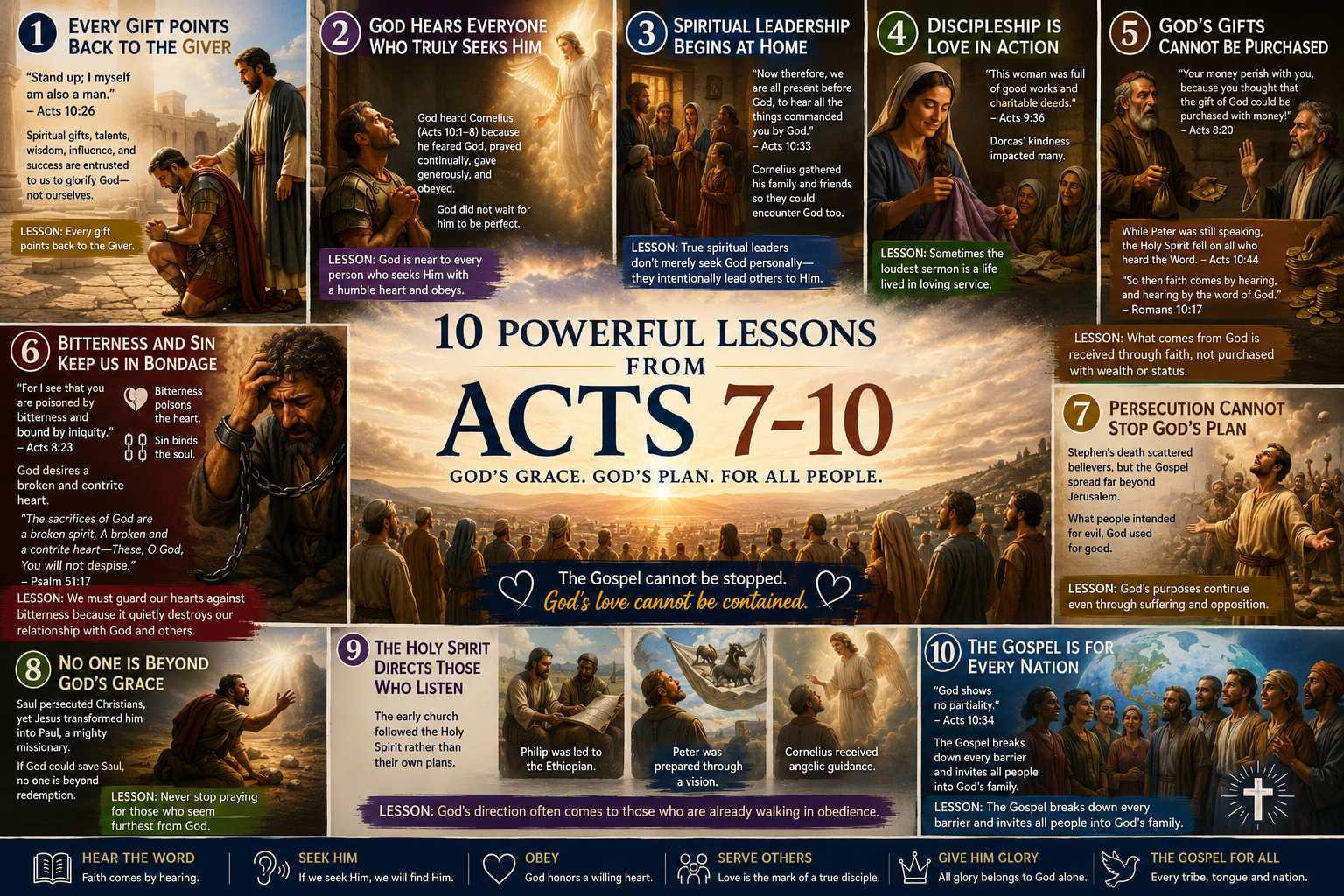

1. God’s Gifts Are Never Meant to Glorify the Recipient
Throughout Acts, God performs extraordinary miracles through ordinary people—Stephen, Philip, Peter, and others. Yet the focus is never on the individual but on God who works through them.
Peter demonstrated this beautifully when Cornelius fell at his feet in reverence:
“Stand up; I myself am also a man.” (Acts 10:26)
Likewise, spiritual gifts, talents, wisdom, influence, and success are entrusted to us to glorify God—not ourselves.
Lesson: Every gift points back to the Giver.
2. God Hears Everyone Who Truly Seeks Him
Cornelius was not a Jew. He was a Roman centurion.
Yet because he feared God, and prayed continually, and gave generously, God heard his prayers and sent an angel to him (Acts 10:1–8).
This teaches us that God responds to sincere seekers, not pure in heart only, not righteous only, but all who wallow in sin but reach out and seek Him – Even while we were still sinners, He died for us.
God did not wait for Cornelius to become perfect before revealing Himself. And we notice that he was also obedient, and spirit sensitive – despite not having the revelation and the Holy Spirit in him.
Lesson: God is near to every person who genuinely seeks Him with a humble heart. Those who have the hunger for Him. All Cornelius needed to do is obey the word, which showed his quest to know God, and think about it, God could have send the angel to Peter or the Holy Spirit could have instructed Peter to go to Cornelius, yet it was Cornelius who was instructed to send for Peter! He could have ignored yet he did not.
3. Spiritual Leadership Begins at Home
When Peter arrived, Cornelius had already gathered his relatives and close friends.
“Now therefore, we are all present before God, to hear all the things commanded you by God.” (Acts 10:33)
Cornelius understood that encountering God was not only for himself but for everyone under his influence.
Especially for fathers and heads of households, there is a responsibility to lead their families toward Christ.
Lesson: True spiritual leaders don’t merely seek God personally—they intentionally lead others to Him.
4. Discipleship Is Demonstrated Through Love in Action
Acts 9 introduces Dorcas (Tabitha).
She is described not because she preached sermons or performed miracles, but because:
“This woman was full of good works and charitable deeds.” (Acts 9:36)
Her acts of kindness had such an impact that the widows wept, showing Peter the garments she had made for them.
Serving Christ is not limited to preaching.
Kindness, generosity, hospitality, encouragement, and compassion are also powerful expressions of discipleship.
Lesson: Sometimes the loudest sermon is a life lived in loving service.
5. God’s Gifts Cannot Be Purchased
Simon the Sorcerer witnessed the Holy Spirit being given through the apostles and attempted to buy that power.
Peter’s response was direct:
“Your money perish with you, because you thought that the gift of God could be purchased with money!” (Acts 8:20)
The Holy Spirit, salvation, grace, and spiritual gifts are never commodities for sale.
They are freely given by God’s grace.
Also, notice Acts 10:44, Whiel Peter was still speaking the word of God, the Holy Spirit fell on all who heard the word. Not those who were touched, but all who heard (sought the truth and received it in their hearts) – Faith comes from hearing, and hearing by the word of God.
“So then faith comes by hearing, and hearing by the word of God.” (Romans 10:17, NKJV)
Lesson: What comes from God is received through faith, not purchased with wealth or status. He says, if we seek Him, we willf ind Him.
6. Bitterness and Sin Keep Us in Bondage
Peter discerned Simon’s true condition. When we do not truly persive the futility in the earthly possessions that we seek and hold, we forget that they cannot buy eternal life, neither can they buy teh gifts of God:
“For I see that you are poisoned by bitterness and bound by iniquity.” (Acts 8:23)
This verse reveals two dangerous spiritual realities:
- Bitterness poisons the heart.
- Sin binds the soul.
A person may appear religious yet still be enslaved internally.
Freedom comes through repentance and surrender to Christ. The best sacrifice is your brocken spirit, a broken and contrite heart – These He came to make whole.
“The sacrifices of God are a broken spirit,
A broken and a contrite heart—
These, O God, You will not despise.”
— Psalm 51:17 (NKJV)
Lesson: We must guard our hearts against bitterness because it quietly destroys our relationship with God and others.
7. Persecution Cannot Stop God’s Plan
Stephen’s death appeared to be a victory for the enemies of the Gospel.
Instead, it became the catalyst that scattered believers and spread the message of Christ far beyond Jerusalem.
What people intended for evil, God used for good.
Lesson: God’s purposes continue even through suffering and opposition.
8. No One Is Beyond God’s Grace
Saul persecuted Christians with great zeal.
Yet Jesus transformed him into Paul, one of history’s greatest missionaries.
If God could save Saul, no one is beyond redemption.
Lesson: Never stop praying for those who seem furthest from God.
9. The Holy Spirit Directs Those Who Listen
Philip was led to the Ethiopian official.
Peter was prepared through a vision.
Cornelius received angelic guidance.
The early church constantly followed the Holy Spirit rather than their own plans.
Lesson: God’s direction often comes to those who are already walking in obedience.
10. The Gospel Is for Every Nation
Peter’s visit to Cornelius changed the course of church history.
He realized that God’s salvation was never intended for one nation alone.
“God shows no partiality.” (Acts 10:34)
The Church is built from every tribe, language, people, and nation.
Lesson: The Gospel breaks down every barrier and invites all people into God’s family.